
The Way Delhi Manages Diabetes Is Changing
If you have been living with diabetes in Delhi — juggling a demanding work schedule, navigating the city’s rich food culture, and trying to stay consistent with your medications — you already know how exhausting it can feel to stay on top of your blood sugar. The traditional approach of pricking your finger three to four times a day, logging numbers in a diary, and hoping your next HbA1c comes back acceptable? For millions of Delhi patients, that approach simply is not working anymore.
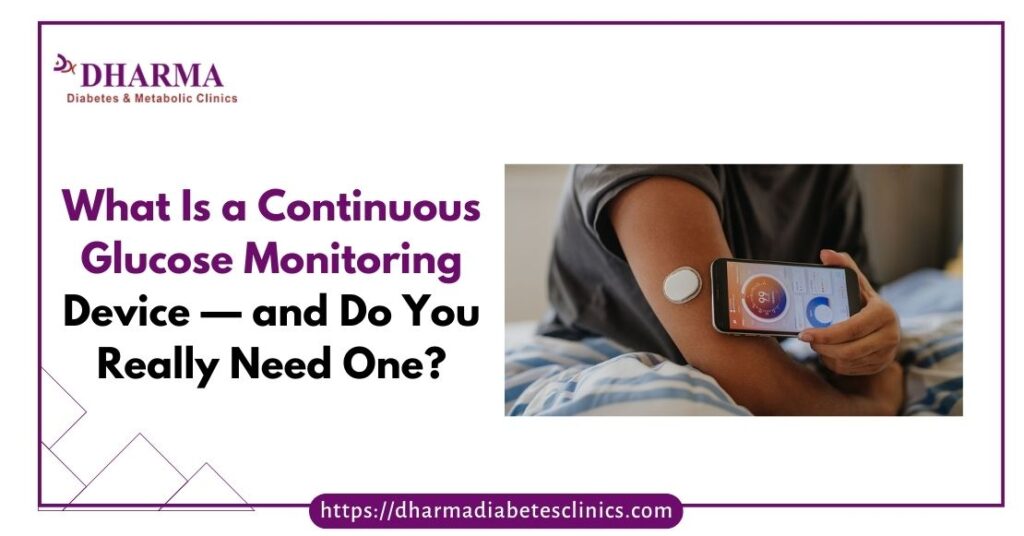
The good news is that diabetes monitoring technology has advanced dramatically. Today, a continuous glucose monitoring system can track your blood sugar automatically, every 5 minutes, around the clock — without a single finger prick. It sends real-time glucose readings directly to your smartphone, alerts you before dangerous highs or lows occur, and generates a detailed 14-day glucose map that gives your doctor more clinical insight in a single review session than months of manual glucose logs ever could.
At Dharma Diabetes & Metabolic Clinics in Greater Kailash, New Delhi, Dr. Mudit Sabharwal FRCP (UK) has been using continuous glucose monitoring as a central pillar of personalised diabetes care for years. In this guide, he explains exactly what a CGM monitor is, how it works, who needs it, what it costs in Delhi, and why it may be the single most important upgrade you can make to your diabetes management in 2026.
What Is Continuous Glucose Monitoring?
Continuous glucose monitoring — commonly called CGM — is a wearable medical technology that measures the glucose level in the fluid between your body’s cells (called interstitial fluid) automatically, at regular intervals throughout the day and night. A constant glucose monitoring device records up to 288 glucose readings every 24 hours — compared to the 3 to 6 readings most patients manage with a traditional glucometer.
Unlike a standard glucometer that only tells you what your blood sugar is at one isolated moment, a continuous blood glucose monitor shows you the full story: where your glucose started, how it moved after meals, what happened to it overnight, how it responded to exercise, and — critically — where it is heading right now. That last point matters more than most patients realise.
A CGM monitor does not just show your current glucose number. It shows a trend arrow — rising rapidly, rising slowly, stable, falling slowly, or falling rapidly. Knowing that your glucose is 130 mg/dL and falling fast is a completely different clinical situation from knowing it is 130 mg/dL and stable.
This is the fundamental difference between a sugar monitor powered by CGM technology and a traditional glucometer. One gives you a photograph. The other gives you a live video.
Dr. Sabharwal explains: “I tell my patients in Delhi that their glucometer is like checking the weather at 8 AM. Their CGM is like watching the weather forecast for the next 24 hours. Both are useful, but only one helps you prepare.”
How Does a CGM Monitor Work? The Technology Explained Simply
A CGM monitor system has four essential components, all working together seamlessly:
1. The Sensor
The core of any continuous blood glucose monitor is a tiny, flexible filament — thinner than a human hair — that is inserted just beneath the skin, typically on the upper arm or abdomen. This sensor sits in the interstitial fluid and measures glucose concentration every few minutes without requiring any blood. Modern sensors are worn continuously for 10 to 14 days before replacement, are waterproof, and cause no meaningful discomfort during daily wear.
2. The Transmitter
Attached to the sensor, the transmitter in your constant glucose monitoring device wirelessly sends glucose readings to your smartphone or reader via Bluetooth or NFC technology. In advanced systems like the Dexcom G7 and FreeStyle Libre 3, glucose data streams to your phone every 5 minutes automatically — no scanning required.
3. The Smartphone App or Reader
This is what you actually see. Your sugar monitor app displays your current glucose level, the trend arrow, a rolling glucose graph for the past 1 to 8 hours, and historical data going back 90 days. The app sends vibration and sound alerts when your glucose approaches unsafe levels — giving you time to act before a crisis develops.
4. The Clinical Data Report
At Dharma Diabetes & Metabolic Clinics, the most valuable use of your continuous blood glucose monitor data happens when Dr. Sabharwal reviews your full Ambulatory Glucose Profile (AGP) after a 14-day sensor session. This report provides a complete map of your glucose patterns — your average levels, your Time in Range (TIR), your glucose variability, your peak and trough timings — and becomes the clinical foundation for recalibrating your entire treatment plan.
Types of CGM Devices Available in Delhi (2026)
Not all CGM monitors are built the same. Here is a practical guide to the major constant glucose monitoring device options currently available to Delhi patients:
FreeStyle Libre 2 & 3 (Abbott)
The most widely used continuous glucose monitoring system in India. The Libre 2 requires you to scan the sensor to get a reading, but sends optional alarms for dangerous lows and highs. The Libre 3 streams glucose continuously to your phone via Bluetooth without any scanning. Both use 14-day sensors and are the most cost-accessible CGM option in the Delhi market.
Approximate cost: ₹3,500 – ₹5,000 per sensor
Dexcom G6 & G7
The gold standard continuous blood glucose monitor for Type 1 diabetes management and complex Type 2 cases. The Dexcom G7 is factory-calibrated (no finger pricks required), streams real-time data, and can predict a hypoglycaemic episode up to 20 minutes before it occurs. It also integrates directly with insulin pumps for closed-loop therapy. This sugar monitor system is the most clinically advanced option available in India.
Approximate cost: ₹5,000 – ₹7,500 per sensor
Medtronic Guardian 4
Designed specifically for use with Medtronic insulin pump systems as part of a closed-loop “artificial pancreas” setup. This continuous glucose monitoring device is primarily used for patients on insulin pump therapy at specialist centres such as Dharma Diabetes & Metabolic Clinics.
Approximate cost: ₹6,000 – ₹9,000 per sensor
SIBIONICS & Sinocare
Newer, more affordable CGM monitor platforms are entering the Indian market, offering continuous sugar monitoring at a lower price point. Suitable for patients who want CGM-assisted management on a tighter budget.
Approximate cost: ₹2,000 – ₹3,500 per sensor
Who Needs a Continuous Glucose Monitoring Device in Delhi?
Continuous glucose monitoring is no longer exclusively for patients with Type 1 diabetes on insulin pumps. At Dharma Diabetes & Metabolic Clinics in Greater Kailash, Dr. Sabharwal recommends a constant glucose monitoring device for a much broader range of patients:
Patients with Type 1 Diabetes
A continuous blood glucose monitor is essentially mandatory for Type 1 diabetes management. The unpredictable nature of glucose swings in Type 1 — particularly overnight — makes a CGM monitor a clinical safety device, not just a monitoring tool.
Patients with Type 2 Diabetes on Insulin
If you are a Delhi patient taking insulin for Type 2 diabetes, a sugar monitor with continuous tracking can identify the precise timing and dose adjustments needed for your specific glucose response pattern — eliminating the guesswork that leads to both hypoglycaemic episodes and persistent hyperglycaemia.
Patients with High Glucose Variability
Some patients have an HbA1c that looks acceptable on paper, but are experiencing frequent glucose swings that their HbA1c result masks entirely. A continuous glucose monitoring session reveals this variability in complete detail — often explaining symptoms like fatigue, brain fog, and mood instability that patients had attributed to other causes.
Pregnant Women with Gestational Diabetes
Pregnancy demands the tightest possible glucose control. A CGM monitor enables safe, real-time monitoring for gestational diabetes patients without the physical and emotional burden of multiple daily finger pricks. Dharma Diabetes & Metabolic Clinics offers dedicated gestational diabetes programmes supported by continuous blood glucose monitor technology.
Patients in the Dharma Diabetes Reversal Programme
Patients enrolled in Dr. Sabharwal’s structured diabetes reversal therapy use a constant glucose monitoring device as the primary measurement tool for their programme. Seeing in real time how specific dietary changes, exercise protocols, and lifestyle modifications affect their glucose response is the most powerful evidence-based motivator in reversal medicine.
Patients with Undetected Nocturnal Hypoglycaemia
Do you wake up with unexplained headaches, fatigue, night sweats, or morning grogginess despite adequate sleep? These are classic symptoms of overnight glucose drops that only a continuous sugar monitoring device can detect and document. This is one of the most commonly missed diagnoses in Delhi’s diabetes-treating community — and one of the most straightforward to address once identified.
Active Professionals and Athletes
Delhi’s growing community of health-conscious professionals and recreational athletes use a sugar monitoring machine to understand how different workouts, meal timings, and stress levels interact with their glucose metabolism in real time.
CGM vs Traditional Glucometer: What Delhi Patients Need to Know
Many patients ask Dr. Sabharwal whether a continuous blood glucose monitor can replace their traditional glucometer entirely. Here is an honest comparison:
| Feature | Glucometer | CGM / Sugar Monitor |
| Readings per day | 3–6 manual | Up to 288 automatic |
| Finger pricks needed | Every reading | None (most modern devices) |
| Overnight monitoring | Impossible | Full continuous coverage |
| Post-meal spike detection | Only if tested at exact peak | Complete curve automatically captured |
| Trend direction | Not shown | Real-time arrow — rising / stable / falling |
| Nocturnal low alerts | Not possible | Alarm before dangerous drop |
| Doctor review data | Manual diary | Full AGP report — 14-day glucose map |
| HbA1c reduction evidence | Modest | 0.8% – 1.2% average reduction in 3 months |
For most patients on oral diabetes medications, a continuous glucose monitoring device can comfortably replace daily glucometer testing. For insulin-dependent patients, Dr. Sabharwal at Dharma Diabetes & Metabolic Clinics will advise whether occasional calibration finger pricks are still recommended alongside your CGM monitor.
Continuous Glucose Monitoring and HbA1c: Understanding Both Together
One of the most common questions Dr. Sabharwal receives from Delhi patients is: “I already do my HbA1c every 3 months — why do I also need continuous glucose monitoring?”
The answer is that these two tests measure fundamentally different things. Your HbA1c gives you a single average number covering 90 days. Your continuous blood glucose monitor gives you the granular, day-by-day, meal-by-meal, hour-by-hour data that the HbA1c average completely conceals.
Consider two patients, both with an HbA1c of 7.2%. Patient A has consistently stable glucose sitting between 100 and 160 mg/dL throughout the day. Patient B spends half the day above 200 mg/dL and the other half below 70 mg/dL — dangerous highs and dangerous lows that average out to 7.2%. Their HbA1c results look identical. Their actual metabolic risk is completely different. Only a constant glucose monitoring device reveals this distinction.
This is why at Dharma Diabetes & Metabolic Clinics, Dr. Sabharwal uses a metric called Time in Range (TIR) alongside HbA1c. TIR — only measurable through a sugar monitor with continuous tracking — tells us what percentage of the day your glucose sits within the safe zone of 70 to 180 mg/dL. International diabetes guidelines now recommend a TIR above 70% as a clinical target in its own right.
| TIR Target | Patient Group | HbA1c Equivalent |
| Above 70% | Most Type 1 & Type 2 adults | Below 7.0% |
| Above 50% | Elderly / high hypoglycaemia risk | Below 8.0% |
| Above 90% | Gestational diabetes | Below 6.5% |
What to Expect at Dharma Diabetes & Metabolic Clinics: Your CGM Journey
Starting continuous glucose monitoring at Dharma Diabetes & Metabolic Clinics in Greater Kailash, New Delhi is a structured, clinically supervised process — not simply a matter of buying a device and hoping for the best. Here is what your journey looks like:
Step 1 — Consultation with Dr. Mudit Sabharwal.
Dr. Sabharwal reviews your full medical history, current medications, most recent HbA1c results, and the overall picture of your diabetes control. As the leadingsugar specialist at Dharma Diabetes & Metabolic Clinics, he determines whether continuous blood glucose monitor technology is clinically appropriate and recommends the right CGM monitor for your specific needs and budget.
Step 2 — Sensor Application at the Clinic
Our trained clinical team applies the constant glucose monitoring device sensor at the clinic — a procedure that takes under two minutes and causes minimal discomfort. You leave wearing the sensor and immediately begin recording continuous sugar monitoring data.
Step 3 — 14 Days of Real-World Monitoring
You carry on with your normal Delhi life — eating your regular meals, commuting, working, exercising, attending social events, sleeping — while your sugar monitoring machine records your glucose response to every variable automatically. You can view your live glucose trends on your smartphone throughout the day.
Step 4 — AGP Review and Treatment Recalibration
After 14 days, Dr. Sabharwal conducts a comprehensive review of your continuous glucose monitoring data using your Ambulatory Glucose Profile report. This review is where the real clinical value is delivered — identifying hidden patterns, unexpected spikes, medication gaps, and dietary triggers that transform your treatment plan from generic to genuinely personalised.
CGM at Dharma: Local Delhi Insights That Matter
As a diabetes clinic in Delhi serving patients across Greater Kailash, Lajpat Nagar, Saket, South Delhi, and Gurugram, Dharma Diabetes & Metabolic Clinics has specific insights into how continuous glucose monitoring data looks for Delhi patients that general guides cannot provide:
Delhi’s food culture creates specific CGM patterns. The classic Delhi diet — paranthas at breakfast, rice or roti at lunch, street food in the evening — produces glucose spike patterns that are distinct from Western dietary profiles. Dr. Sabharwal uses your continuous blood glucose monitor data to give you specific, Delhi-relevant dietary guidance rather than generic international diet advice.
Air conditioning, heat, and pollution affect glucose. Delhi’s extreme seasonal temperature swings — from 45°C summers to cold winters — along with chronic exposure to air pollution, measurably affect insulin sensitivity and glucose levels. Continuous sugar monitoring data reveals these environmental effects on your specific metabolism.
Delhi commute stress is real. Extended commuting, traffic stress, and erratic meal timing are among the most common glucose destabilisers in Delhi patients. A CGM monitor makes these patterns visible and actionable.
Fasting and festival seasons. Delhi’s rich festival calendar — Karwa Chauth, Navratri, Ramzan fasts — creates specific glycaemic challenges. Constant glucose monitoring device data allows Dr. Sabharwal to guide patients safely through extended fasting periods without dangerous hypoglycaemia.
Your 14-Day CGM Report Starts Here Walk in. Get fitted. Change how you manage diabetes — for good.
About Dr. Mudit Sabharwal — Delhi’s CGM Specialist
Dr. Mudit Sabharwal is the Medical Director of Dharma Diabetes & Metabolic Clinics, Greater Kailash Enclave-2, New Delhi. Holding an MBBS and FRCP (UK) — a Fellowship of the Royal College of Physicians, one of the most prestigious medical credentials in the world —
Dr. Sabharwal brings over 18 years of specialist clinical experience in diabetes and metabolic medicine to every patient consultation.
Widely recognised as the best diabetes doctor in Delhi for complex and treatment-resistant cases, Dr. Sabharwal has been using continuous glucose monitoring technology as a clinical tool for years, long before it became mainstream in India. His approach combines the precision of CGM monitor data, the long-term picture provided by HbA1c, and the patient’s individual lifestyle context to build treatment plans that are both clinically rigorous and genuinely liveable.
At Dharma Diabetes & Metabolic Clinics, continuous blood glucose monitor technology is not an optional add-on. It is a core part of how Dr. Sabharwal delivers the personalised, data-driven diabetes care that has made Dharma one of Delhi’s most trusted specialist diabetes clinics.
Frequently Asked Questions About CGM in Delhi
Q1. Is continuous glucose monitoring painful?
No. The sensor insertion feels like a mild pinch and takes under a second. Once placed, most patients forget it is there. It is waterproof and comfortable for everyday wear.
Q2. How much does a CGM sensor cost in Delhi?
CGM sensors in Delhi cost between ₹2,000 and ₹9,000, depending on the brand. FreeStyle Libre is the most popular option at ₹3,500–₹5,000 per sensor. Dr. Sabharwal at Dharma Diabetes & Metabolic Clinics recommends the right device based on your needs and budget.
Q3. Does health insurance cover CGM in India?
Some premium insurance plans cover CGM for Type 1 diabetes patients. Coverage for Type 2 is less common. Dharma Diabetes & Metabolic Clinics can provide the clinical documents needed to support your insurance claim.
Q4. Can a CGM replace my finger-prick glucometer?
Yes, for most patients on oral diabetes medications. For patients on insulin, occasional finger-prick checks may still be needed. Your doctor will advise based on your specific treatment plan.
Q5. What is the difference between a CGM and an insulin pump?
A CGM measures glucose — it does not deliver insulin. An insulin pump delivers insulin continuously. When used together as a closed-loop system, the CGM reads glucose and the pump automatically adjusts insulin in real time.
Q6. How often should I use a CGM?
Type 1 and insulin-dependent Type 2 patients benefit from year-round CGM use. For other patients, a 14-day CGM session every 3 months — aligned with HbA1c testing — gives excellent clinical value without the full ongoing cost.
Q7. Is CGM safe during pregnancy for gestational diabetes?
Yes. CGM is safe during pregnancy and is increasingly recommended for gestational diabetes. It helps maintain tighter glucose control for both mother and baby without multiple daily finger pricks.
Q8. What is Time in Range (TIR)?
Time in Range is the percentage of the day your glucose stays between 70 and 180 mg/dL. A TIR above 70% is the recommended clinical target. Only a CGM can measure it — your HbA1c cannot.
Q9. Where can I get CGM in South Delhi?
Dharma Diabetes & Metabolic Clinics in Greater Kailash, New Delhi, offers complete CGM services — consultation, sensor fitting, and 14-day data review with Dr. Mudit Sabharwal. Patients from Saket, Lajpat Nagar, Hauz Khas, Janak Puri, and Gurugram regularly visit the clinic.
Q10. Can children with Type 1 diabetes use CGM?
Yes. CGM is safe for children and is now the standard of care for paediatric Type 1 diabetes. Both FreeStyle Libre and Dexcom are approved for children. Dr. Sabharwal at Dharma Diabetes & Metabolic Clinics provides dedicated paediatric diabetes consultations.
