

Yoga poses for diabetes, such as Mandukasana, Balasana, Shavasana, and Ardha Matsyendrasana might be able to aid individuals with diabetes in being flexible, relaxed, and well. In addition, Anulom Vilom might aid in the management of stress. Yoga would complement diabetes treatment; however, there is no specific yoga posture that can treat diabetes or serve as a replacement for medication.
Yoga for diabetes can be a useful supplement to an existing diabetic management plan. It can help with exercising, being flexible and reducing stress levels, while some research suggests better glucose control in Type 2 diabetics. Yoga Poses can be selected according to flexibility, comfort, and individual health needs.
In the case of Dharma Diabetes & Metabolic Clinics, emphasis is laid on integrating suitable activities in one’s lifestyle along with effective diabetes treatment. Yoga Poses can be selected according to flexibility, comfort, and individual health needs. Beginner-friendly Yoga Poses allow individuals to start at a comfortable pace.
Ready to take your diabetes management to the next level? Consult an expert today for a combined plan of medication and yoga.
How Does Yoga for Diabetes Help Management?
Yoga is made up of movements, breath control and relaxation. Suitable Yoga Poses can support relaxation, mobility, and balance. There is some evidence that shows that the practice of yoga regularly in addition to regular treatments can be beneficial in some metabolic conditions in patients suffering from type 2 diabetes. This depends on the person; no yoga posture has been found to produce insulin.
1. Stress Reduction and Cortisol Control
Blood sugar control can be affected by stress through hormones and behaviors. Yoga, breathing exercises, and relaxation could help alleviate stress and promote mental health, which might facilitate the ability to have healthy habits. Gentle Yoga Poses may help support relaxation and stress management.
2. Boosting Insulin Sensitivity
Review and meta-analysis of 16 studies on 1,820 patients revealed that yoga sessions may help to reduce blood sugar and HbA1c levels in type 2 diabetes patients. Nonetheless, outcomes were inconsistent among different studies, and there is no significant evidence to prove that specific yoga postures trigger insulin release from pancreas. Yoga Poses should complement prescribed diabetes treatment rather than replace it.
3. Improving Circulation and Nerve Health
Diabetes often leads to complications in the feet, eyes, and kidneys due to poor circulation and nerve damage (neuropathy). Yoga poses for diabetes enhance peripheral blood flow, ensuring better nutrient and oxygen supply to these critical areas, and acting as a protective mechanism against long-term complications.
4. Supporting Weight and Metabolic Balance
While not a substitute for intense cardio, consistent yoga in diabetes practice encourages lean muscle mass, reduces visceral fat, and promotes mindful eating, which is vital for patients seeking the best yoga poses for diabetes control.
10 Essential Yoga Poses for Diabetes Control (Suggested by Experts)
The following yoga poses for diabetes are selected for their targeted action on the abdominal organs and their proven ability to reduce stress. Remember, always practice safely, preferably on an empty stomach (or 3-4 hours after a heavy meal), and stop if you feel any pain. These Yoga Poses offer different levels of movement, stretching, and relaxation. Choose Yoga Poses that match your physical ability and comfort level.
Here is a quick comparison of 10 yoga poses for diabetes, their main purposes, and beginner-friendly modifications to help you choose suitable exercises.
| Yoga Pose | Main Purpose | Suggested Beginner Approach |
|---|---|---|
| Mandukasana | Gentle mobility | Modify or avoid abdominal compression |
| Ardha Matsyendrasana | Spinal mobility | Use a mild seated twist |
| Paschimottanasana | Hamstring flexibility | Bend only as far as comfortable |
| Bhujangasana | Back mobility | Start with a gentle lift |
| Balasana | Relaxation | Use a cushion if needed |
| Shavasana | Stress relief | Rest comfortably for 3–5 minutes |
| Tadasana | Balance and posture | Stand near a wall for support |
| Supta Baddha Konasana | Hip flexibility | Support the knees with cushions |
| Pawanmuktasana | Gentle mobility | Bring one knee in at a time |
| Supta Matsyendrasana | Spinal mobility | Use a comfortable, shallow twist |
1. Mandukasana (Frog Pose)
Mandukasana is one of the Yoga Poses that requires care because it places pressure on the abdomen.
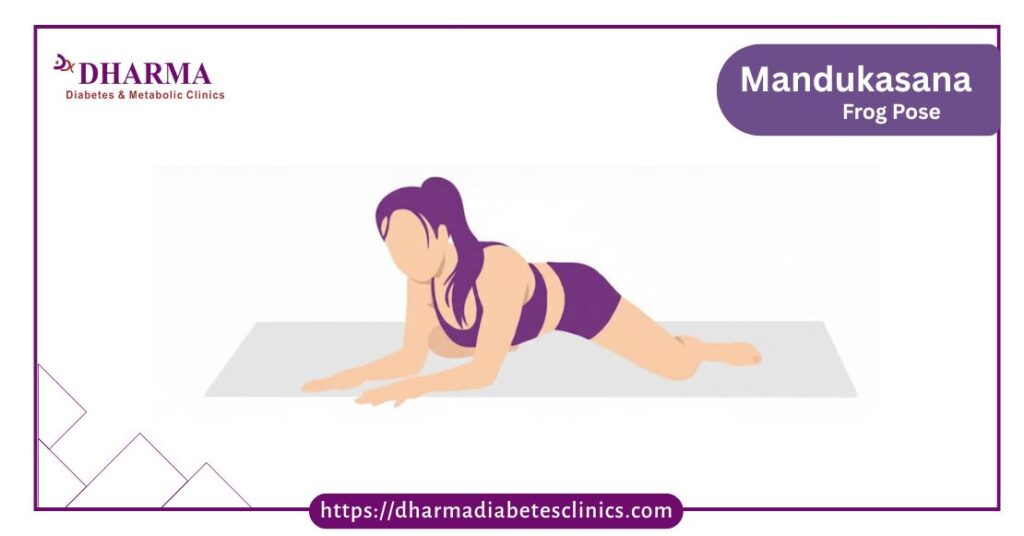
- Targeted Benefit for Diabetes: May support hip and lower-back flexibility, but it is not proven to stimulate pancreatic insulin production.
Caution: Skip or modify this pose if you have a hernia, have had recent abdominal surgery, or are pregnant the direct pressure on the abdomen isn’t suitable for these conditions.
- Steps to Perform:
- Start in Vajrasana (Thunderbolt Pose).
- Clench your right fist and place it against your navel. Place your left palm over the right fist.
- Inhale deeply, and as you exhale, bend forward from your hips, pressing the fists into the abdomen.
- Try to touch your forehead to the ground, keeping your hips on your heels.
- Hold for 30–60 seconds, maintaining slow, deep breathing.
2. Ardha Matsyendrasana (Half Lord of the Fishes Pose)
Ardha Matsyendrasana is one of the Yoga Poses that supports gentle spinal mobility and flexibility when performed comfortably.
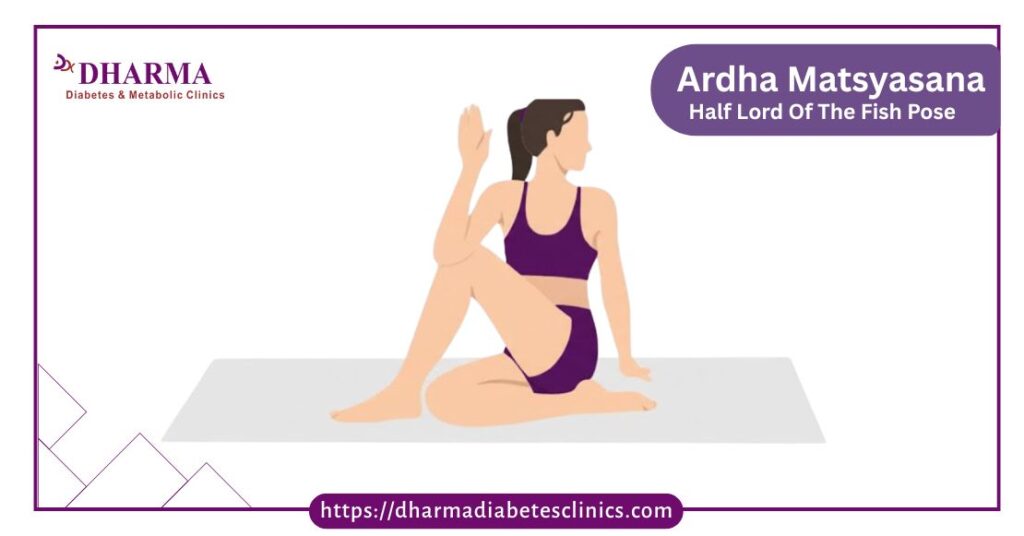
- Targeted Benefit for Diabetes: A seated spinal twist that may improve mobility and flexibility. Direct detoxification or pancreatic benefits are not established.
Caution: If you have gestational diabetes or are pregnant, avoid deep twists like this one; ask your doctor for a modified, gentler variation instead.
- Steps to Perform:
- Sit with legs extended (Dandasana). Bend your right knee and place your right foot flat on the floor outside your left thigh.
- Bend your left knee and bring the left foot near your right hip.
- Inhale, raise your left arm, and then, while exhaling, wrap it around your right thigh, placing your left hand on your right foot or knee.
- Place your right hand on the floor behind your back and gently twist your torso to the right.
- Hold for 30 seconds, then repeat on the other side.
3. Paschimottanasana (Seated Forward Bend)
Paschimottanasana is among the Yoga Poses that stretch the hamstrings and back while encouraging relaxation.
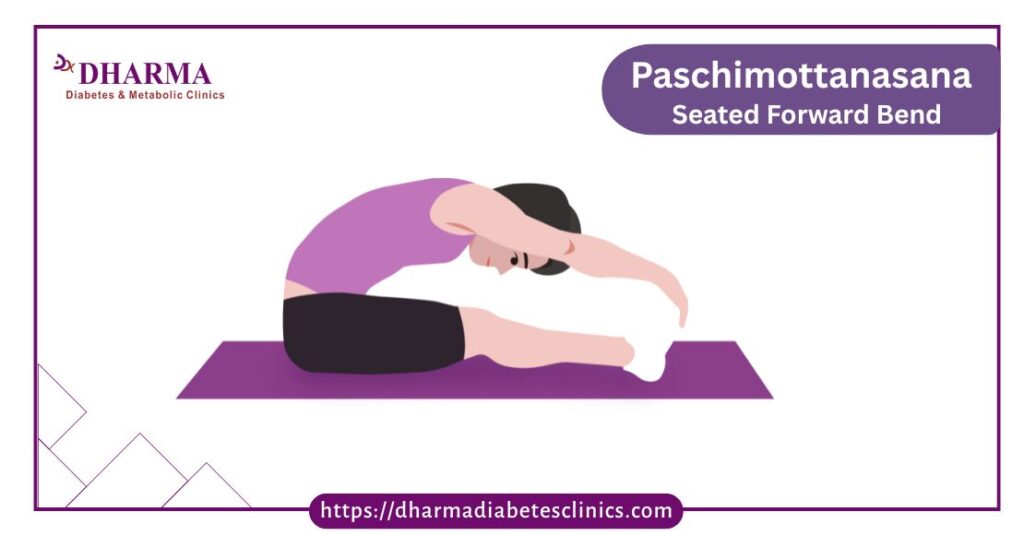
- Targeted Benefit for Diabetes: Helps stretch the back and hamstrings and may support relaxation when performed comfortably.
Caution: If you have a hernia or a severe disc issue, avoid the full forward bend a gentler, supported version is safer.
- Steps to Perform:
- Sit with legs extended in front, feet together, and spine straight.
- Inhale, raising your arms overhead to lengthen the spine.
- Exhale, hinging at the hips, and reach for your toes, ankles, or shins.
- Keep the back as straight as possible, avoiding rounding.
- Hold the pose for 30–60 seconds.
4. Bhujangasana (Cobra Pose)
Bhujangasana is one of the Yoga Poses that helps improve spinal mobility and posture through a gentle backbend.
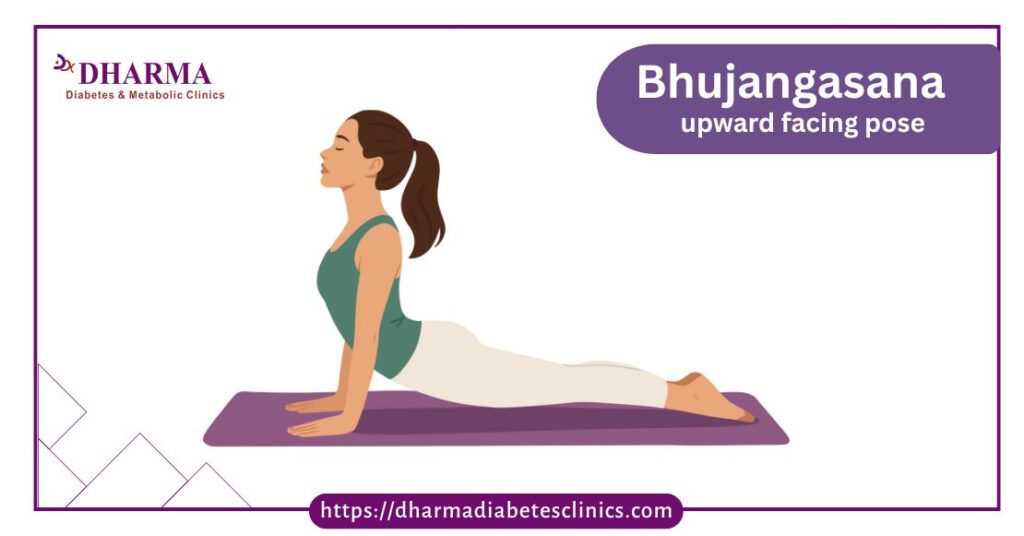
- Targeted Benefit for Diabetes: A gentle backbend that may improve spinal mobility and posture. It has not been proven to increase insulin production.
Caution: This pose involves lying on the stomach, which isn’t recommended during pregnancy or for gestational diabetes.
- Steps to Perform:
- Lie on your stomach, with your forehead on the floor.
- Place your palms flat on the floor beneath your shoulders, elbows close to your body.
- Inhale and gently lift your head and chest off the floor, keeping a slight bend in the elbows and pressing your pubic bone into the floor.
- Hold for 20-30 seconds, then release on an exhale.
5. Balasana (Child’s Pose)
Balasana is among the gentle Yoga Poses that promote relaxation, comfortable stretching, and mindful breathing.
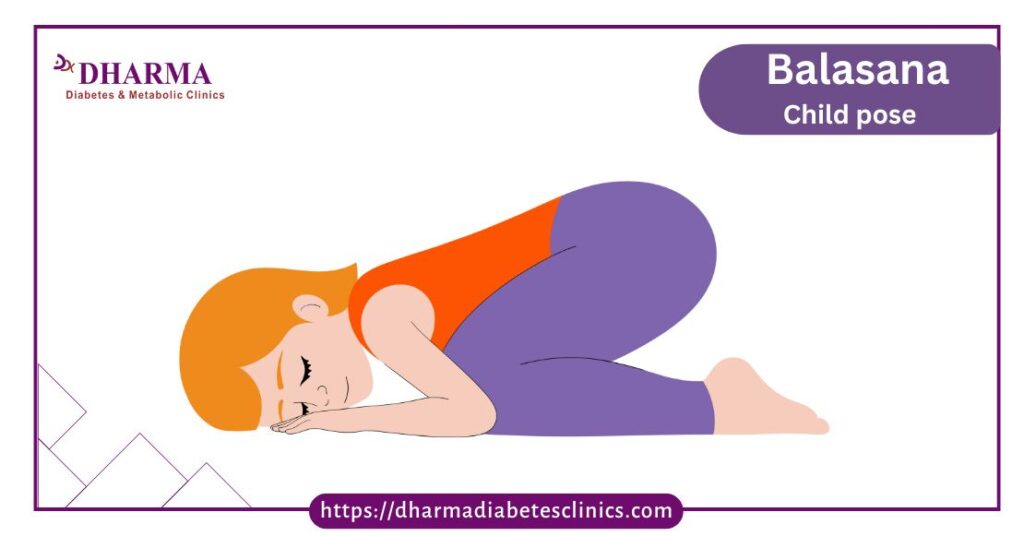
- Targeted Benefit for Diabetes: A restorative posture that may help reduce tension and promote relaxation.
- Steps to Perform:
- Kneel on the floor, touching your big toes together. Separate your knees hip-width apart.
- Exhale and lay your torso down between your thighs.
- Stretch your arms forward or rest them alongside your body, palms up.
- Rest your forehead on the floor. Hold for 1–3 minutes.
6. Shavasana (Corpse Pose)
Shavasana is one of the restorative Yoga Poses that encourages relaxation and helps calm the mind.
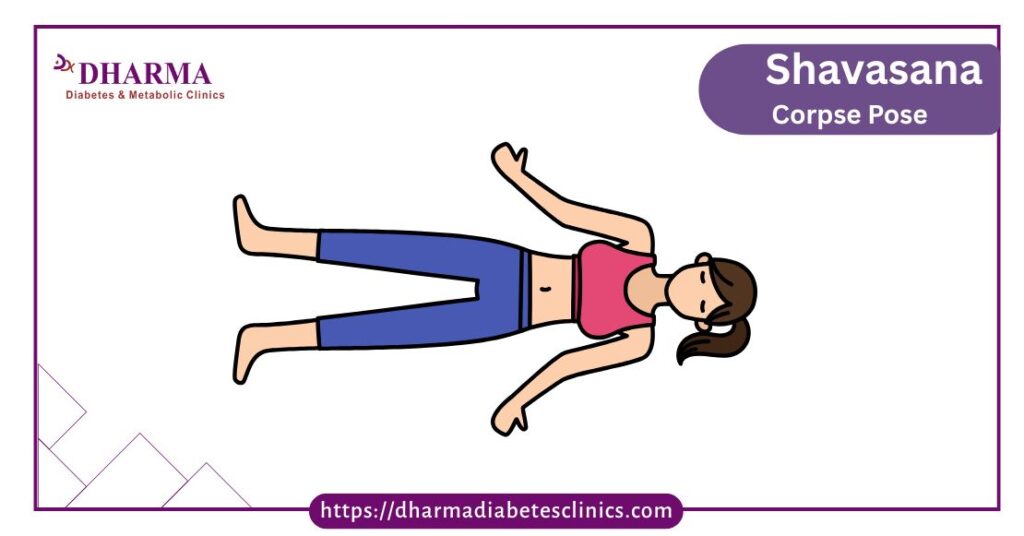
- Targeted Benefit for Diabetes: A relaxation pose that may help calm the mind and support stress management.
- Steps to Perform:
- Lie flat on your back, feet slightly wider than your hips, arms resting alongside your body, palms facing up.
- Close your eyes and consciously relax every part of your body from your toes to your head.
- Remain still and quiet for 5–10 minutes.
7. Tadasana (Mountain Pose)
Tadasana is one of the standing Yoga Poses that supports posture, balance, and body awareness.
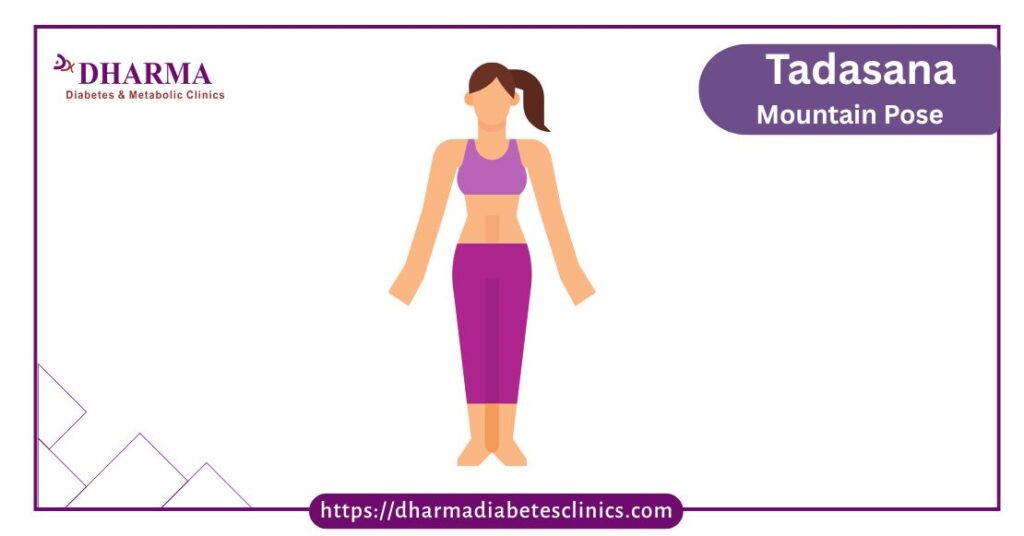
- Targeted Benefit for Diabetes: Helps develop posture, body awareness, and balance when performed safely.
Caution: If you have severe neuropathy or balance issues, keep your heels on the ground rather than rising onto your toes.
People with numbness, reduced foot sensation, or balance difficulties should modify standing poses and follow proper diabetic foot care guidance to reduce their risk of injury.
- Steps to Perform:
- Stand straight on flat ground with your legs together, and arms stretched out on the sides, palms up.
- Inhale and slowly raise your arms above your head, interlocking your fingers and turning the palms upward.
- Rise up onto your toes, stretching the body as high as possible.
- Hold the position for 30 to 40 seconds, then exhale and slowly lower your heels and arms.
- Repeat the exercise 10-15 times.
8. Supta Baddha Konasana (Reclining Bound Angle Pose)
Supta Baddha Konasana is among the relaxing Yoga Poses that gently stretch the hips and support comfortable rest.
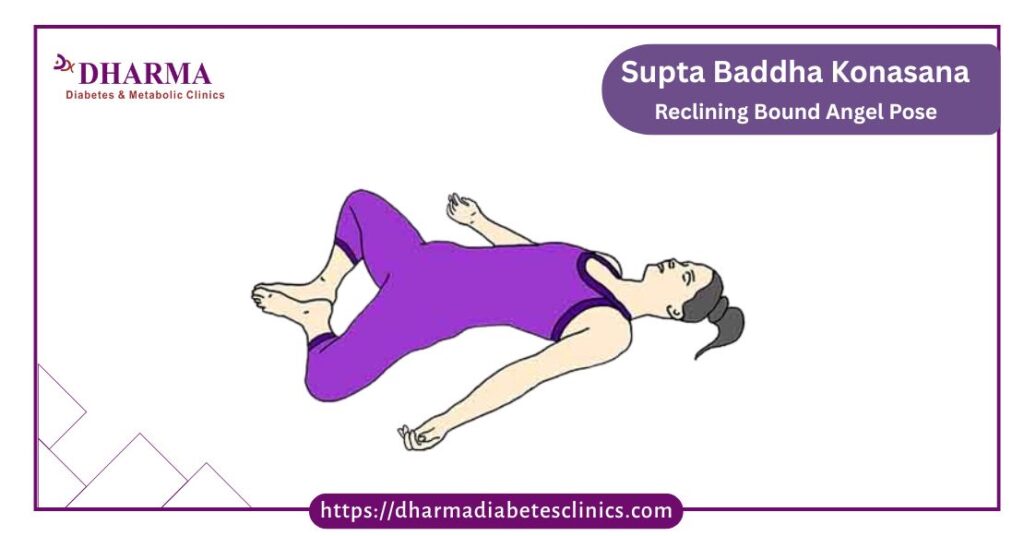
- Targeted Benefit for Diabetes: A gentle resting posture that may support hip flexibility and relaxation.
- Steps to Perform:
- Lie down on your back. Bend your knees and bring the soles of your feet together, allowing your knees to drop out to the sides.
- Rest your arms alongside your body, palms up, or place one hand on your heart and one on your abdomen.
- Hold the position for 2 to 5 minutes, focusing on deep, slow breaths.
- To release, gently bring your knees back together.
9. Pawanmuktasana (Wind Relieving Pose)
Pawanmuktasana is one of the Yoga Poses that encourages gentle movement and flexibility through a knee-to-chest stretch.
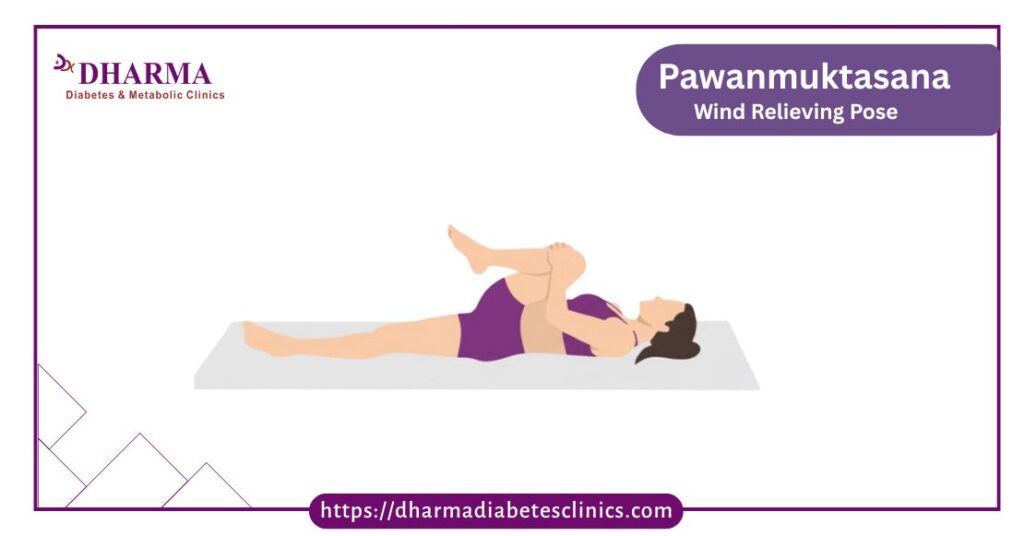
- Targeted Benefit for Diabetes:A knee-to-chest movement that may support gentle mobility and comfort but is not proven to lower glucose directly.
- Steps to Perform:
- Lie on your back, legs extended.
- Bend your right knee and pull it toward your chest, clasping your hands around the shin.
- Lift your head, attempting to touch your knee with your forehead.
- Hold for 20–30 seconds. Release. Repeat with the left leg, and finally, bring both knees to the chest together.
- Repeat the process 10 times.
10. Supta Matsyendrasana (Supine Spinal Twist)
Supta Matsyendrasana is one of the reclining Yoga Poses that supports gentle spinal mobility and relaxation.
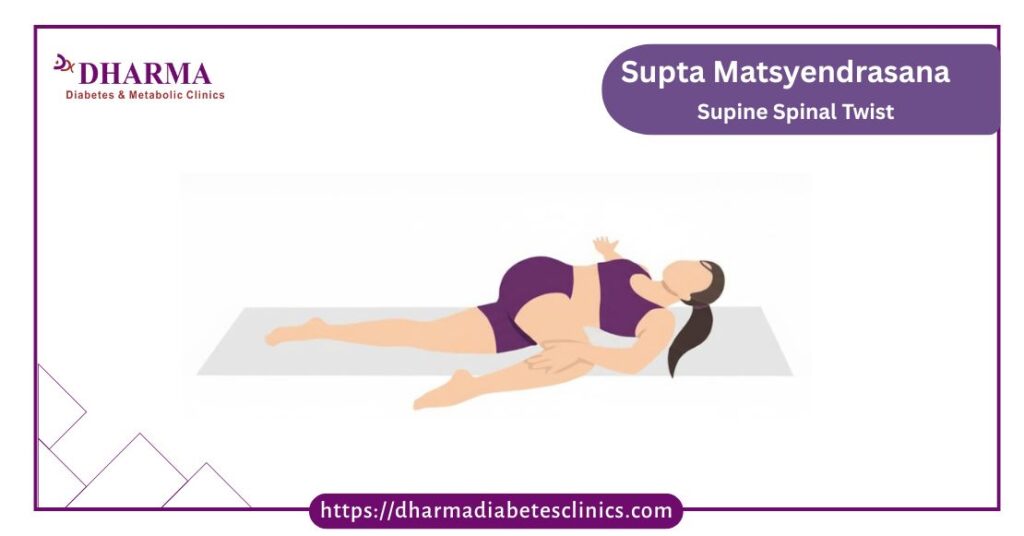
- Targeted Benefit for Diabetes: A reclining twist that may improve gentle spinal mobility and help with relaxation.
Caution: As with other twists, modify or skip this pose if you’re pregnant or managing gestational diabetes.
- Steps to Perform:
- Lie on your back, arms stretched out to the sides like a ‘T’.
- Bend your knees into your chest, then drop both knees to the right side, keeping your shoulders pressed into the floor.
- Turn your head to the left.
- Hold for 1 minute, and repeat on the other side.
Choosing the Right Yoga Poses
Choosing the right Yoga Poses depends on your comfort, flexibility, and individual health needs. Beginners can start with gentle poses such as Balasana and Shavasana before gradually developing a consistent routine. Some Yoga Poses may require modifications for people with diabetic neuropathy, eye complications, or balance difficulties. Consult your healthcare professional before starting a new yoga routine to ensure that the selected poses are appropriate for your condition.
Benefits of Yoga Poses for Diabetes
Yoga Poses can be a helpful addition to a diabetes management routine by supporting flexibility, balance, and relaxation. Gentle movements may help reduce stress and encourage regular physical activity. People with diabetes should choose suitable Yoga Poses according to their fitness level, mobility, and existing health conditions. Regular practice should always complement prescribed medication, balanced nutrition, and medical guidance.
Best Pranayama for Diabetes
Pranayama refers to the process of performing breathing techniques, which may aid in reducing stress and helping relax. These techniques include Anulom Vilom and Bhramari and can be incorporated into a simple yoga practice regimen for diabetics.
None of the pranayama techniques have ever cured diabetes or helped lower sugar levels.
1. Anulom Vilom for Diabetes
Alternate Nostril Breathing (Anulom Vilom) is often performed to induce a sense of relaxation and focus. While it may help reduce stress levels, it does not have a known effect on HbA1c levels.
How to practise:
- Sit comfortably with your back straight.
- Gently close your right nostril and inhale through the left.
- Close your left nostril and exhale through the right.
- Continue alternating slowly without holding your breath.
Duration: Beginners may start with 3–5 minutes.
Precaution: Avoid forced breathing or breath-holding. Stop if you experience dizziness or discomfort.
2. Bhramari Pranayama
Humming Bee Breathing Technique, known as Bhramari, is a form of breathing technique for calming down purposes.
How to practise:
- Sit in a comfortable position.
- Inhale slowly through your nose.
- Exhale gently while making a humming sound.
- Repeat several times without straining.
Duration: Start with 2–5 minutes, as comfortable.
Precaution: Stop if you feel dizzy or breathless.
3. Is Kapalbhati Good for Diabetes?
Kapalbhati is an aggressive breathing technique that is occasionally suggested for diabetes programs in yoga. There is not enough research to suggest that Kapalbhati on its own can make a noticeable difference to blood sugar or HbA1c.
It might not be right for individuals who have uncontrolled hypertension, serious heart diseases, some types of eye problems, recently had abdominal surgery, or pregnant women. Always consult a medical expert before doing it.
Note: Pranayama is a tool to aid the treatment of diabetes. It cannot substitute medications, balanced food intake, and blood glucose tests.
Is Yoga Safe for People With Diabetes?
Yoga tends to be relatively safe for most patients who have diabetes provided that the exercises chosen are right for them. People on insulin therapy or taking glucose-lowering drugs and having problems such as neuropathy or retinopathy may have to take additional care.
Precautions Before Practising Yoga
- Low blood sugar: Those on insulin therapy and other drugs that may lead to hypoglycemia are advised to adhere to the prescribed glucose monitoring and exercise program.
- Diabetic neuropathy: Use standing pose assistance if you suffer from numbness or have limited sensation in your feet.
- Diabetic retinopathy: It is best to avoid inversions and vigorous breathing or breath-holding in the case of severe retinopathy that is unstable.
- Heart disease or uncontrolled blood pressure: Seek medical advice before strenuous yoga or breathing techniques.
- Pregnancy: Make use of pregnancy safe modifications and do not practice postures that involve abdominal pressure.
Do not continue exercising in case of chest pain, extreme dizziness, unusual breathing difficulties, or signs of hypoglycemia.
Remember: Yoga should be chosen according to your diabetes type, medicines, physical ability, and possible complications.
How to Start a Daily Yoga Routine for Diabetes
Consistency trumps timing, but beginners should be comfortable and start slow. Those new to exercise can take small steps and gradually work towards a regular routine based on comfort level, medication, and glucose levels.
15-Minute Beginner Yoga Routine
| Exercise | Duration |
|---|---|
| Gentle warm-up | 2 minutes |
| Tadasana | 2 minutes |
| Balasana or a seated alternative | 2 minutes |
| Gentle seated spinal twist | 2 minutes |
| Anulom Vilom | 3 minutes |
| Shavasana | 4 minutes |
It is only an example of routine and not scientifically validated exercise routine for diabetes patients. Beginners can modify and skip some poses as per their condition and physical fitness level.
What Is the Best Time to Do Yoga for Diabetes?
Yoga can be done either in the morning or evening according to your choice. There is no proven information that yoga done in the morning hours will always help in managing the levels of glucose in the body effectively.
Do not perform vigorous exercises right after having a big meal. On the other hand, those who have been prescribed insulin injections or diabetes medications cannot perform on an empty stomach.
Along with regular physical activity, following a balanced diabetic diet and taking prescribed medicines can support long-term blood sugar management.
Can Yoga Replace Walking or Other Exercise?
Not necessarily, Yoga can aid in developing flexibility, balance, and relaxation, whereas walking and resistance training offer extra benefits in terms of metabolism and cardiovascular health. A well-rounded plan for diabetes exercises may involve all three activities, depending on individual requirements.
Dr. Sabharwal’s expert advice and yoga routine to start managing your blood sugar naturally today.
Comprehensive FAQs: Your Diabetes & Yoga Questions Answered
Q1: Can yoga help reduce the risk of type 2 diabetes?
Yes. Regular yoga for diabetes can improve insulin sensitivity, support weight management, reduce stress, and lower the risk of developing type 2 diabetes.
Q2: Which yoga poses are best for diabetes control?
Poses like Mandukasana, Ardha Matsyendrasana, Paschimottanasana, and Balasana are among the best yoga poses for diabetes control, as they help stimulate the abdominal organs, reduce stress, and support overall well-being.
Q3: How often should I practice yoga for diabetes?
Practice yoga for diabetes for 30–60 minutes at least 4–5 days a week. Regular practice provides better blood sugar control and long-term health benefits.
Q4: Is yoga safe for people with diabetes?
Most people can safely practice yoga. However, if you have diabetic retinopathy, high blood pressure, gestational diabetes, or severe neuropathy, avoid high-risk poses and consult a diabetes doctor in Delhi before starting.
Q5: Can yoga reduce diabetes medications?
Yoga may help improve blood sugar levels, but it should never replace prescribed medicines. Always consult a diabetes doctor in Delhi before making any changes to your treatment.
Q6: Which breathing exercises are good for diabetes?
Anulom Vilom and Kapalbhati are effective breathing exercises that reduce stress, improve metabolism, and support yoga for diabetes management.
Q7: Is yoga enough to control diabetes?
No. Yoga for diabetes works best when combined with a healthy diet, regular physical activity, and medical guidance from experts at Dharma Diabetes & Metabolic Clinics.
Q8: How long does yoga take to show results for diabetes?
With consistent practice, many people notice improvements in energy and stress within weeks, while blood sugar levels may improve within 3–6 months. For personalized diabetes care, consult a diabetes doctor in Delhi at Dharma Diabetes & Metabolic Clinics.
Q9: Is it safe to do yoga if I have diabetic retinopathy or neuropathy?
Yoga for diabetes is still beneficial, but modify poses if you have complications. Avoid inversions and forceful breathing with diabetic retinopathy. If you have diabetic neuropathy, be careful with balance poses and practice under expert guidance.
Q10: Is yoga better than walking for diabetes?
Yoga for diabetes and walking work best together. Walking helps lower blood sugar and improves heart health, while yoga improves insulin sensitivity, flexibility, and stress management for better diabetes control.
Summary: Important Facts About Yoga for Diabetes
Yoga for diabetes patients is beneficial for flexibility, stress relief, and general wellbeing. There are some findings showing that practicing yoga regularly might improve blood sugar levels in people suffering from Type 2 diabetes along with conventional treatment.
- Most useful yoga poses: Mandukasana, Ardha Matsyendrasana, Balasana, Shavasana, and some other easy poses might contribute to mobility and relaxation.
- Best pranayama techniques: Anulom Vilom and Bhramari are recommended to relax, but it is not clear how they affect blood sugar.
- Routine for beginners: Yoga beginners should do 10-15 minutes of yoga daily and then gradually increase duration.
- Safety issues: People who have neuropathy, retinopathy, heart problems, or risk of hypoglycemia should consider using special modifications in their exercises.
- Diabetes control: Yoga practice should be accompanied by a healthy diet, regular physical activity, medications, and glucose testing.
Conclusion: There is no one specific yoga pose for diabetes patients. Regular practice may be one of the components of the proper control of the disease.
Take Control of Your Health Journey Today!
Achieving optimal diabetes management requires expertise, commitment, and a holistic approach that integrates medical science with lifestyle practices like yoga for diabetes. Dr. Mudit Sabharwal and the team at Dharma Diabetes & Metabolic Clinics are dedicated to guiding Delhi residents towards better health outcomes.
We don’t just treat symptoms; we empower you with the knowledge and tools to manage your condition comprehensively. Whether you need an official diagnosis, a review of your current medication, or guidance on the best yoga poses for diabetes control, our diabetes clinic in Delhi is your trusted partner.
Don’t wait to embrace a healthier life.
Book your consultation with Dr. Mudit Sabharwal today to create a personalized, integrated treatment plan that truly works for you.
