
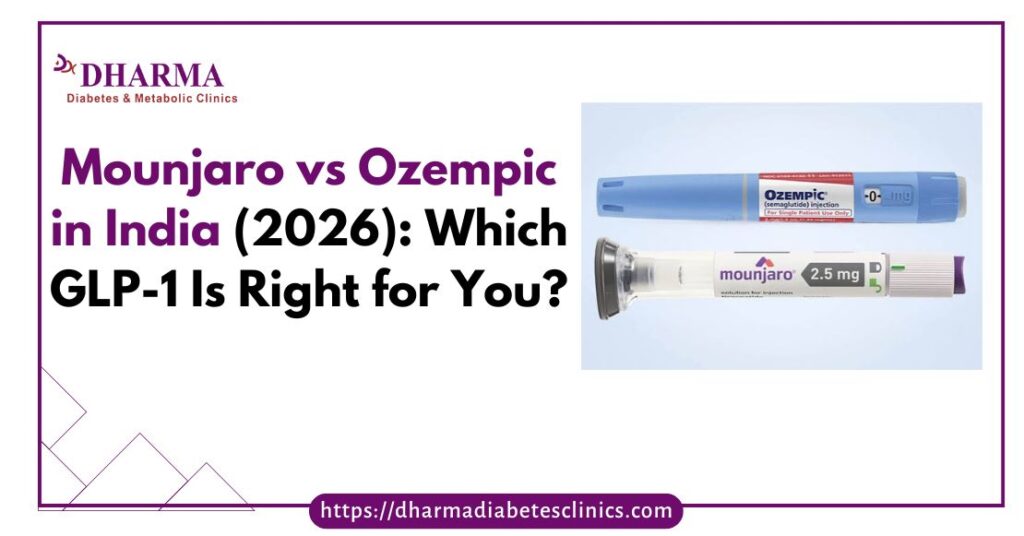
Quick answer: In the Mounjaro vs Ozempic comparison, Mounjaro (tirzepatide) produces a bigger drop in HbA1c (up to 2.5%) and more weight loss (15-20%) than Ozempic (semaglutide, up to 1.5% HbA1c, 10-15% weight loss), but it costs nearly double ₹14,000-17,500 a month versus Ozempic’s ₹8,800-11,175. Ozempic also has longer-term heart and kidney safety data. There is no universal winner in the Mounjaro vs Ozempic debate the right choice depends on your HbA1c, weight, budget, and heart or kidney risk, decided with a diabetes specialist, not a friend’s recommendation.
If you’ve spent any time on a diabetes forum or WhatsApp family group lately, you’ve probably seen the same Mounjaro vs Ozempic debate on repeat which one actually works, and which one is worth the money? At Dharma Diabetes & Metabolic Clinics, this is now one of the most common questions patients bring to Dr. Mudit Sabharwal in consultation, right alongside “what’s my HbA1c” and “do I need insulin.”
This guide breaks the Mounjaro vs Ozempic decision down honestly no hype, no “miracle injection” language so you can walk into your next appointment with the right questions.
What Are Mounjaro, Ozempic, and Rybelsus?
All three belong to a drug class called GLP-1 receptor agonists, originally developed to treat type 2 diabetes and later found to cause significant weight loss as a side effect.
- Ozempic (semaglutide): a weekly injection, CDSCO-approved in India, that mimics the GLP-1 hormone your gut releases after eating. It nudges the pancreas to release insulin, slows digestion, and reduces appetite.
- Mounjaro (tirzepatide): also a weekly injection, but it acts on two hormone receptors instead of one: GLP-1 and GIP. This “dual agonist” action is a big part of why this comparison tends to favour Mounjaro on blood sugar and weight loss.
- Rybelsus: the oral (tablet) form of semaglutide. Same active ingredient as Ozempic, but taken daily by mouth on an empty stomach, for patients who want the GLP-1 benefit without needles.
In practical terms: Mounjaro vs Ozempic is a question of “how strong an effect do I need,” while Rybelsus is a question of “am I comfortable with an injection at all.”
Mounjaro vs Ozempic: The Clinical Comparison
Mounjaro vs Ozempic for Blood Sugar Control (HbA1c)
This is usually the first thing Dr. Sabharwal checks with patients weighing this decision. In clinical trials, Mounjaro has shown HbA1c reductions of up to 2.5%, compared to roughly 1.5% with Ozempic. For someone with an HbA1c stubbornly stuck above 8-9% despite metformin, that gap can be clinically meaningful.
Mounjaro vs Ozempic for Weight Loss
Weight loss is where this comparison gets the most attention online. Trial data generally shows:
- Mounjaro: 15-20% body weight reduction over 12-18 months
- Ozempic: 10-15% body weight reduction over a similar period
If weight is the primary driver not just blood sugar Mounjaro’s dual-hormone mechanism gives it an edge for most patients.
Mounjaro vs Ozempic: Heart and Kidney Protection
This is the point most price-comparison articles skip, and it matters. Ozempic has years more real-world data and is specifically approved to reduce the risk of major cardiovascular events heart attack, stroke and to slow the progression of diabetic kidney disease in people with type 2 diabetes. Mounjaro doesn’t yet carry those specific approvals, though trials are ongoing. For a patient with existing heart disease or early kidney involvement, this single factor can tilt the Mounjaro vs Ozempic decision toward Ozempic even if Mounjaro offers more weight loss.
Mounjaro vs Ozempic: Side Effects
Both drugs share a similar side-effect profile, since they work through overlapping pathways nausea, mild stomach upset, and reduced appetite in the first few weeks, usually settling as the dose is increased gradually. Neither causes dangerous low blood sugar on its own unless combined with insulin or sulfonylureas.
Not everyone is a candidate for either drug see our full guide on who should avoid GLP-1 medications before starting.
Mounjaro vs Ozempic: Cost in India (2026)
Cost is often the deciding factor once the clinical picture is clear, and this is where the Mounjaro vs Ozempic gap widens considerably.
| Medication | Approx. Monthly Cost (India, 2026) |
| Mounjaro (tirzepatide) | ₹14,000 – ₹27,500 (dose-dependent) |
| Ozempic (semaglutide) | ₹5,660 – ₹9,100 (post April 2026 price cut) |
| Generic semaglutide (from March 2026) | ₹1,290 – ₹4,200 |
| Rybelsus (oral semaglutide) | ₹3,000 – ₹10,000 |
The launch of generic semaglutide in India from March 2026 is a genuine turning point in this pricing story it brings a clinically proven GLP-1 option within reach of far more patients, without the guesswork of unregulated “grey market” imports. Dr. Sabharwal advises patients firmly against sourcing any GLP-1 medication outside a licensed pharmacy with a valid prescription, given the well-documented risk of counterfeit vials online.
Novo Nordisk cut Ozempic and Wegovy prices by up to 48% in April 2026 after semaglutide’s patent expiry opened the door to generics. For a full pharmacy-by-pharmacy breakdown, see our GLP-1 cost in Delhi guide, and for a full safety rundown of the generic options now available, see our semaglutide generics guide.
Mounjaro vs Ozempic: Who Should Choose Which?
Who Should Consider Mounjaro?
Mounjaro tends to win the Mounjaro vs Ozempic decision for patients who:
- Have obesity (BMI ≥30) or are overweight with metabolic risk factors, and weight loss is the primary goal
- Have an HbA1c that hasn’t responded well to metformin or older GLP-1 drugs
- Don’t have a strong personal or family history of cardiovascular disease that specifically needs Ozempic’s proven protective data
- Can sustain the higher monthly cost for the 12+ months typically needed for lasting results
Who Should Consider Ozempic (or Generic Semaglutide)?
Ozempic or its upcoming generic version often wins out for patients who:
- Have existing heart disease, a history of stroke, or early diabetic kidney disease
- Want strong, well-established long-term safety data before committing
- Are working within a tighter monthly budget, especially once generics arrive
- Are comfortable with a slightly smaller, but still substantial, drop in HbA1c and weight
- generic semaglutide options after patent expiry
Who Should Consider Rybelsus?
Rybelsus suits patients who want the metabolic benefits of semaglutide but are unwilling or unable to self-inject a common concern among newly diagnosed patients and older adults, and a reason some skip the injection debate altogether. The trade-off is a stricter dosing routine: it must be taken on an empty stomach with a small sip of water, then no food, drink, or other medication for 30 minutes.
Mounjaro vs Ozempic: How Treatment Is Monitored
Whichever way the Mounjaro vs Ozempic decision goes, GLP-1 therapy isn’t a “start and forget” injection. A structured monitoring plan typically includes:
- Baseline labs: HbA1c, fasting glucose, kidney function, and lipid profile before starting
- Gradual dose escalation: starting at the lowest dose for 4 weeks and increasing only if tolerated, to minimise nausea
- Follow-up HbA1c: usually at 12 weeks to confirm the medication is working as expected
- Weight and waist circumference tracking: alongside diet and activity counselling, since medication alone rarely sustains results without lifestyle support
- Screening for rare but serious side effects, including pancreatitis symptoms and gallbladder issues, especially in the first few months
- what happens if you stop treatment: check full details
Patients on continuous glucose monitoring often see the clearest, fastest feedback on how their body responds to either option one more reason a supervised program beats a self-directed one.
Monitoring doesn’t stop when you finish treatment — most patients regain weight without a planned exit strategy. See our guide on preventing GLP-1 weight regain for what to do before you stop.
Mounjaro vs Ozempic: Myths Worth Clearing Up
“Mounjaro is just a stronger Ozempic, so it’s always the better choice.” Not quite in the Mounjaro vs Ozempic decision, stronger isn’t automatically better if you have heart or kidney disease, where Ozempic’s track record currently carries more weight.
“Once you’re on it, you can stop dieting.” Both drugs work best alongside not instead of dietary changes and activity. Studies following patients after stopping GLP-1 therapy show weight regain within about 18 months without sustained lifestyle changes.
“Buying online without a prescription is fine if the price is good.” It isn’t. Counterfeit vials sold outside licensed pharmacies are a real and growing risk in India, and dosing errors without medical supervision can be dangerous, no matter which option you choose.
Why the Mounjaro vs Ozempic Decision Matters More in a City Like Delhi
Delhi’s diabetes numbers aren’t small a large share of the city’s adult population is already living with type 2 diabetes or prediabetes, and lifestyle pressures like long commutes, high-stress work culture, and a food environment built around refined carbohydrates make weight management genuinely harder here than in many other cities. That’s part of why this conversation has generated so much local interest: patients are looking for something that works alongside not as a replacement for the diet and activity changes that are already difficult to sustain in a fast-paced urban routine. Air quality and disrupted sleep patterns, both well documented as metabolic stressors for Delhi residents, add another layer that a purely medication-first approach won’t solve on its own. A good GLP-1 program in Delhi has to account for all of this, not just the prescription itself.
GLP‑1 drugs like Mounjaro and Ozempic are not safe for everyone, especially people with certain thyroid problems, pancreatitis, severe stomach issues, or women who are pregnant or breastfeeding. If you are unsure whether you fall into a high‑risk group, read our detailed guide on who should avoid GLP‑1 medications before starting any injection: Who should not take GLP‑1 drugs?
The Final Word on Mounjaro vs Ozempic
This decision isn’t really about which drug is “stronger” it’s about which one fits your specific health profile safely and sustainably. Both are genuine advances in diabetes and obesity care, and both deserve a proper medical evaluation rather than a self-prescribed trial based on a friend’s results. If you’re weighing Mounjaro vs Ozempic for yourself, book a consultation to get an HbA1c-based, personalised recommendation instead of guessing.
Frequently Asked Questions
Is Mounjaro better than Ozempic for weight loss?
Mounjaro typically leads to greater weight loss (about 15–20% of body weight) than Ozempic (around 10–15%). However, the best option depends on your health, medical history, and treatment goals.
Which is cheaper, Mounjaro or Ozempic, in India?
Ozempic is generally more affordable, costing about ₹8,800–₹11,175 per month, while Mounjaro costs around ₹14,000–₹17,500 per month. Prices may decrease as generic semaglutide becomes available.
Can I switch from Ozempic to Mounjaro, or the other way around?
Yes, you can switch from Ozempic to Mounjaro, but only under your doctor’s guidance. The new medication is usually started at a low dose to reduce side effects, with follow-up checks to monitor blood sugar and treatment response.
What are the most common side effects of Mounjaro and Ozempic?
Ozempic and Mounjaro can cause nausea, stomach upset, and reduced appetite, especially during the first few weeks. Rare but serious side effects, such as pancreatitis or gallbladder problems, require immediate medical attention.
Is Mounjaro available in India, and do I need a prescription?
Yes, Mounjaro is available in India by prescription, alongside Ozempic. Both medicines should only be purchased from licensed pharmacies with a valid prescription to avoid counterfeit products and unsafe use.
Do I have to stay on Mounjaro or Ozempic forever?
Weight regain is common after stopping Ozempic or Mounjaro unless healthy eating and regular exercise are maintained. For most people, these medications work best as part of a long-term weight management plan under medical supervision.
Is Rybelsus as good as Ozempic injections?
Rybelsus contains the same active ingredient as Ozempic but is taken as a daily tablet instead of a weekly injection. It can be an effective needle-free option when taken correctly on an empty stomach for proper absorption.
