
Medical Disclaimer: This article is for informational purposes only and does not constitute medical advice. Always consult a qualified diabetologist before starting or switching any GLP-1 therapy.
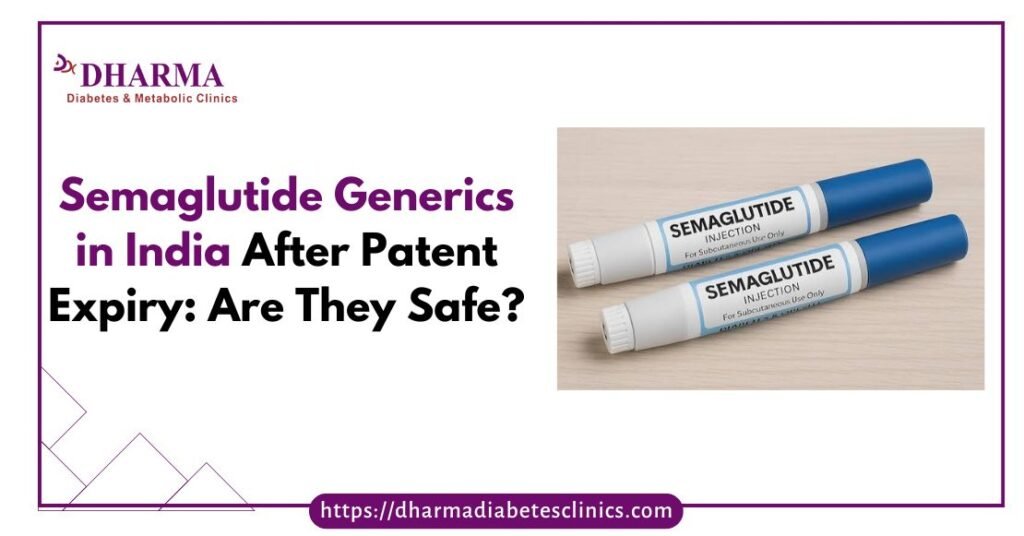
Semaglutide generics in India launched March 21, 2026 the day after Novo Nordisk’s patent expired. Dr. Reddy’s Obeda, Natco Semanat, Glenmark GLIPIQ, and 10+ other brands are now DCGI-approved and available at ₹1,290–₹4,200/month. For a full pricing breakdown across Delhi-NCR pharmacies, see our updated GLP-1 cost guide. The question people actually ask: are these products safe? The short answer is yes they contain the same active molecule as Ozempic. But the real safety issue isn’t the molecule itself; it’s manufacturing quality, cold-chain storage, and whether you’re taking it under medical supervision.
Before you start or stop any generic semaglutide, read our guide on GLP‑1 weight regain after Ozempic and other injections and check who should avoid GLP‑1 drugs because of thyroid, pancreas or pregnancy‑related risks.
At Dharma Diabetes Clinics, Dr. Mudit Sabharwal’s approach to evaluating these products focuses on three things: DCGI approval status, verified pharmacy sourcing, and structured patient monitoring. For patients comparing all GLP-1 options, see our Mounjaro vs Ozempic comparison. Here’s what the clinical data and regulatory framework actually say.
Are These Products Actually Safe?
Yes, they’re safe if DCGI-approved and bought from licensed pharmacies. The active pharmaceutical ingredient (API) in every approved product is identical to Ozempic. The difference is the manufacturer, the delivery device, and the price, not the drug itself.
But there’s a catch: semaglutide is a complex molecule. Even minor manufacturing variations can influence impurity profiles, molecular stability, and potential immunogenicity. Dr. Aparna Govil Bhasker, a Mumbai-based bariatric surgeon, notes that “with many manufacturers entering the market, it will be necessary to maintain consistent quality across brands.” Our clinical experience at Dharma Diabetes Clinics aligns with this view and we recommend patients stick to established manufacturers with documented Phase III or bioequivalence data.
The DCGI requires bioequivalence studies (generics must fall within 80–125% of the innovator’s pharmacokinetic parameters) and GMP-certified manufacturing. Most approved products fall within 95–105%. So the molecule reaching your bloodstream is clinically the same.
The real risk is unverified sources. Online sellers, social media DMs, and unlicensed pharmacies may offer non-DCGI-approved products that bypass quality control entirely.
What DCGI Approval Actually Means
The Drugs Controller General of India (DCGI) operates under the Central Drugs Standard Control Organisation (CDSCO). For a generic semaglutide to receive DCGI approval, the manufacturer must submit:
- Bioequivalence data showing the product performs within 80–125% of Ozempic’s pharmacokinetic parameters
- Phase III clinical trial data (for some brands) demonstrating non-inferior efficacy and comparable safety
- GMP-certified manufacturing facilities meeting Indian and international standards
Dr. Reddy’s Obeda, for example, completed a head-to-head Phase III trial. According to available regulatory filings, this showed non-inferior glycaemic reduction and comparable safety. Alkem’s Semasize bioequivalence study, as reported in CDSCO documentation, showed pharmacokinetic ratios within the regulatory acceptance range.
Standard restrictions apply: contraindicated in type 1 diabetes, medullary thyroid carcinoma history, and MEN2 syndrome.
Do These Products Work as Well as Ozempic?
Yes, the clinical efficacy follows the molecule, not the brand. These products work just as well because they contain the same active ingredient.
The bioequivalence requirement ensures that the amount of drug reaching your bloodstream and the speed at which it acts are clinically equivalent to Ozempic. This applies to all DCGI-approved versions.
For a detailed clinical comparison of Ozempic against Mounjaro, read our full guide. It breaks down expected weight loss, HbA1c drops, and side effects to help you decide which branded option suits your case before considering a generic switch.
However, some patients report perceived differences in real-world use, often linked to device or technique rather than the molecule itself. A vial that requires manual syringe drawing feels different from a pre-calibrated FlexTouch pen. Dosing technique, individual variation, and even confidence in the device can influence how effective a treatment feels even when the pharmacokinetics are identical.
Side Effects, Risks, and What Doctors Watch For
The side effects are identical to Ozempic because it’s the same drug. Common side effects include:
- Nausea, vomiting, abdominal discomfort and pain (most common, ~20–44% in clinical data)
- Constipation and diarrhea
- Muscle loss (with prolonged use)
- Gallstone formation
- Pancreatitis (rare but serious)
Other concerns doctors flag:
- Vision changes in some patients
- Dehydration from GI side effects
- Potential for inappropriate use by people without obesity or diabetes
- Inappropriate use: People without obesity or diabetes using these products for “quick weight loss”
- Lack of long-term data: Real-world safety data for Indian generics is still evolving
- Muscle loss: Prolonged use without proper diet and exercise can lead to sarcopenia
With many pharmaceutical companies expected to introduce these products, doctors raise specific concerns about manufacturing consistency. Not all versions may be safe or give the same results, especially in the early phases after launch. Trace-metal contamination and molecular weight variations can affect safety.
“Patients should only use these medications under medical supervision to avoid self-medication and misuse,” notes Dr. Bhasker. At Dharma Diabetes Clinics, we echo that these products are not a “quick fix” for weight loss and must be used under qualified medical guidance only.
Pregnant women and those breastfeeding must not take this medication.
Switching from Ozempic: What to Consider
If you’re already stable on Ozempic and tolerating it well, the decision to switch is financial, not clinical.
Reasons to consider switching:
- Cost savings: These products can reduce monthly cost significantly 60–85% less than branded Ozempic. See current Delhi-NCR pricing and pharmacy availability.
- Long-term sustainability: GLP-1 therapy is often months or years, not weeks
- Same molecule: No expected change in HbA1c or weight loss trajectory
Reasons to stay on Ozempic:
- Preference for the pen device: FlexTouch is pre-calibrated; generic options use various devices
- Insurance partial coverage: Some OPD riders may cover branded Ozempic for T2D but not generics
- Psychological comfort: Trust in Novo Nordisk’s quality control (though DCGI-approved products meet the same standards)
Don’t switch without talking to your doctor. At Dharma Diabetes Clinics, patients in Delhi-NCR can discuss switching under supervised care at our Greater Kailash or Gurugram centres. Dosing consistency, monitoring schedules, and your specific medical history should all be reviewed.
If you’re switching to manage cost long-term, plan for what happens when you eventually stop see our guide on GLP-1 weight regain and how to prevent it. And regardless of which brand you choose, confirm you’re a safe candidate first: who should avoid GLP-1 drugs.
Buying Online: What’s Safe and What’s Not
Only buy from licensed platforms. These products are Schedule H medications they require a valid prescription from a registered medical practitioner.
However, the easy accessibility and affordability can lead to misuse, self-medication, or use without proper medical evaluation. A major concern is the rise of online and over-the-counter availability, which may bypass proper prescription channels.
Red flags to avoid:
- Social media sellers offering “cheap Ozempic” without prescription
- Unverified websites with no pharmacy license
- Products stored at room temperature (GLP-1 must be refrigerated at 2–8°C)
- Prices that seem too low even for generics (may indicate counterfeit)
Safe platforms in Delhi-NCR: Tata 1MG, Apollo Pharmacy, MedPlus, MR Med all require prescription and maintain cold-chain logistics. In Delhi summers, cold-chain handling is particularly important; these drugs must stay refrigerated from manufacturer to patient, and pharmacies that don’t manage this properly may hand you compromised products.
Do You Need a Prescription?
Yes. All GLP-1 drugs in India, including generic versions, are Schedule H medications. You cannot legally purchase them without a prescription.
Dr. Mudit Sabharwal emphasizes: “It is important to remember that this drug is not a ‘quick fix’ for weight loss and must be used under medical guidance only.” Self-medication, especially driven by social media influencers, is a growing concern as these products make the drug more accessible.
Available DCGI-Approved Options
The table below shows examples of currently available DCGI-approved options. Prices are approximate as of July 2026 and subject to change. Choice depends on individual medical review.
| Brand | Manufacturer | Format | Approx. Monthly Cost | Best For |
| Semanat / Sundae | Natco / Eris | Vial | ₹1,290–₹1,300 | Maximum cost savings |
| GLIPIQ | Glenmark | Vial + Pen | ~₹1,300–₹2,800 | Balance of price + support |
| Semasize | Alkem | Pre-filled pen | ~₹1,800 | Easiest pen experience |
| Semaglyn | Zydus | Reusable pen | ~₹2,200 | Eco-friendly multi-dose |
| Obeda | Dr. Reddy’s | Pre-filled pen | ~₹4,200 | Oral tablet also available |
All products listed above are DCGI-approved. The “best” option depends on your budget, device preference, and whether your pharmacy stocks it reliably.
Frequently Asked Questions
1. Are semaglutide generics in India as safe as Ozempic?
Yes. DCGI-approved products must demonstrate bioequivalence and undergo clinical trials. The active molecule is identical to Ozempic.
2. When did these products launch in India?
March 21, 2026 the day after Novo Nordisk’s patent expired on March 20, 2026.
3. Which companies make semaglutide generics in India?
Dr. Reddy’s (Obeda), Sun Pharma (Noveltreat/Sematrinity), Alkem (Semasize), Zydus (Semaglyn), Glenmark (GLIPIQ), and Natco/Eris (Semanat/Sundae).
4. Has Dr. Reddy’s Obeda been tested against Ozempic?
Yes. According to available Phase III data, a head-to-head trial showed non-inferior efficacy and comparable safety.
5. What is bioequivalence and why does it matter for semaglutide generics in India?
Bioequivalence means these products deliver the same amount of active drug to your bloodstream at the same rate as Ozempic. The DCGI requires them to fall within 80–125% of the innovator’s parameters.
6. Are there any side effects unique to generic versions?
No. Side effects are identical to Ozempic because the active molecule is the same: nausea, diarrhea, vomiting, constipation, and rare risks of pancreatitis or gallbladder issues.
7. Can I buy semaglutide generics in India without a prescription?
No. All are Schedule H medications requiring a valid prescription.
8. Is the vial format less safe than the pen?
No. The drug is identical. Vials require manual drawing with a syringe, which introduces a small risk of dosing error. Pens are pre-dosed and easier to use.
9. How do I verify these products are DCGI-approved?
Check the brand name on the CDSCO database, or ask your pharmacist. Avoid unverified online sellers.
10. Should I switch from Ozempic to semaglutide generics in India to save money?
If you’re stable on Ozempic, switching to a DCGI-approved generic is clinically reasonable and can reduce monthly cost significantly. See updated Delhi-NCR pricing and pharmacy availability. Discuss with your doctor first.
Don’t Switch Blindly
Switching from Ozempic without supervision can lead to dosing errors, missed monitoring, or buying unverified products. Get a structured switch plan from Dr. Mudit Sabharwal at Dharma Diabetes Clinics covering brand selection, cold-chain verification, and follow-up monitoring.
Call/WhatsApp: [+91-75030-20433]
Book online: Chat With Us
Locations: Greater Kailash Enclave-2, New Delhi
